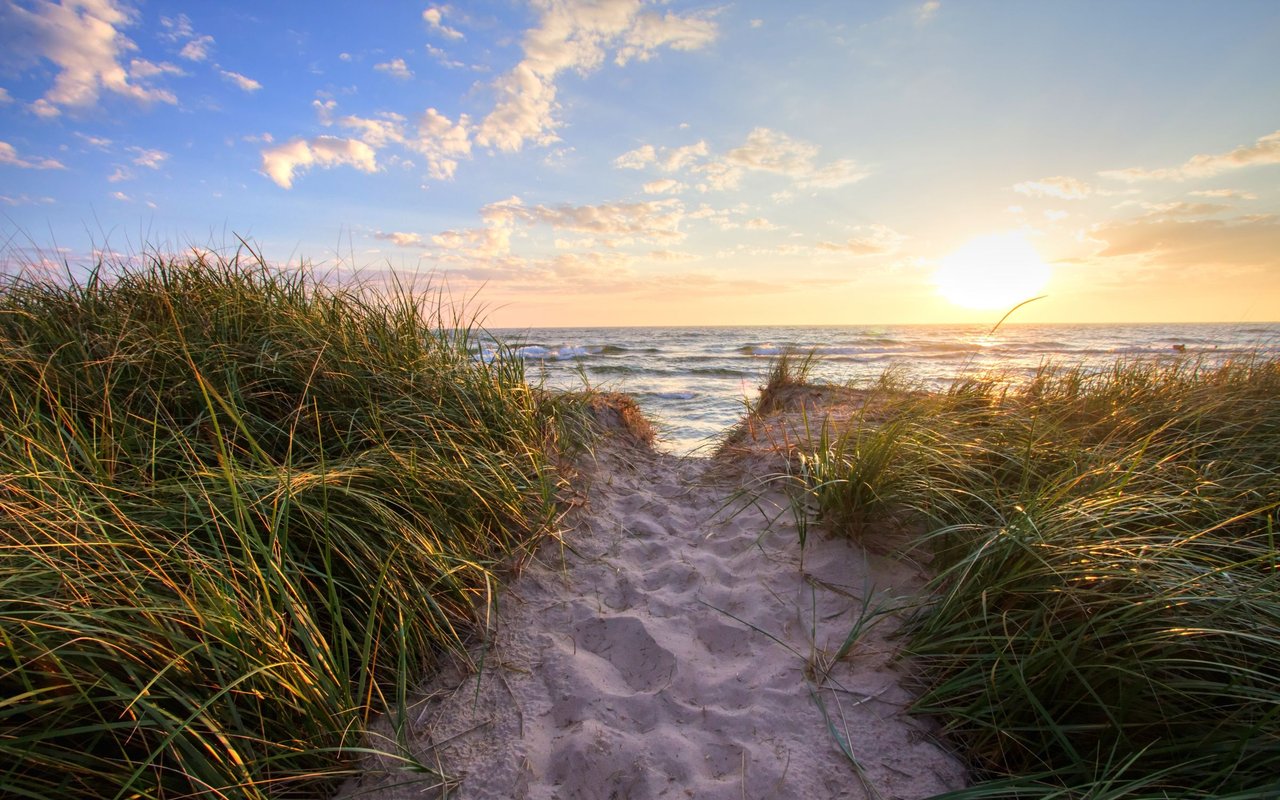
Ask a longtime North Muskegon resident who maintains the nature preserve down on Lake Avenue, and most will guess the same wrong answer: the city, or maybe the county. It has the feel of public land. A boardwalk curls along the Muskegon River. Fishing platforms cantilever out over the water. Kids from the local schools show up in September for outdoor lessons on wetlands. Herons stand around like they're on the payroll.
None of it belongs to any government. The Muskegon Lake Nature Preserve is owned and run by a nonprofit, and that single fact changes how the whole 17 acres actually works.
No City Budget, No County Line Item
The Muskegon Environmental Research and Education Society, known locally as MERES, formed in 1996 as an offshoot of the Muskegon Conservation Club and acquired the land that became the preserve the following year. It sits on the eastern shoreline of Muskegon Lake, right where the Muskegon River empties in, and it has stayed a private 501(c)(3) ever since. No city parks department signs off on its budget. No county millage funds its upkeep.
When the preserve's boardwalk started failing a couple of years ago, a board member named Tom Willi put it plainly to a Fox17 reporter: "We don't receive any tax dollars. None. Zero."
That line explains a lot about why the preserve looks the way it does, patched and cared for by whoever shows up with a shovel or a check, rather than scheduled on a municipal capital improvement plan.
What Erosion Does to a Quarter-Mile Boardwalk
The centerpiece of the preserve is the Wilder River Walk, a 985-foot boardwalk built in 2007 along the Muskegon River, with an additional 400-foot spur connecting it to the paved bike trail. Seven fishing platforms cantilever six feet out from the walkway, and the route ends at the Peter and Sophia Wege observation tower at the west end.
Rising water in the Muskegon River spent years working against the wooden supports underneath it. By early 2024, a 250-foot section had started sinking toward the river, and the fix required something more permanent than lumber. Engineers called for steel pilings to shore up the failing stretch, priced at roughly $46,530. Since MERES has no tax revenue to draw from, that number became a public fundraising campaign instead of a line item, and donations from people who'd walked the boardwalk paid for the repair.
The work didn't stop once the boardwalk was stable again. MERES has since installed a split-rail fence to stop further erosion around the pond and lagoon area, a stretch that had gotten so worn down by foot traffic from anglers that nothing could take root there. Native wildflowers are going in behind the fence now, meant to slow runoff into the water and cut down on the sand and silt clogging a culvert installed during an earlier restoration. A Spark Good grant from the Walmart on Sherman Boulevard is funding a separate project to remove immature black locust trees, a species that spreads through root suckering fast enough to shade out everything else trying to grow underneath it.
None of this is the kind of maintenance a parks department schedules on autopilot. It's the kind that happens because a handful of people decided it should.
Finding It
The preserve doesn't advertise itself with much signage, which is part of why longtime residents sometimes forget it's there. The access point sits off Lake Avenue, about two blocks from the four-way stop where Memorial Causeway, Lake Avenue, Holton Road, and Whitehall Road all meet.
A few things worth knowing before you go:
- Parking is at the preserve entrance off Lake Avenue. There's a gate closing off vehicle access beyond the lot, so you'll walk in from there.
- The paved bike and walking trail connects directly to the Muskegon Lakeshore Trail, so it's possible to start at the preserve and keep going toward downtown Muskegon if you want the longer route.
- The Al Bell Wetland Trail and the Ron Brown Education Pavilion sit closer to the entrance, while the Wilder River Walk itself is farther in, past the entry bridge.
The One Rule That Trips People Up
The preserve lists dog walking among its permitted activities, which is accurate for most of the property. But the specific 0.8-mile interior loop trail mapped on AllTrails is the exception. Dogs aren't allowed on that loop, even though they're welcome on the paved sections elsewhere in the preserve. It's an easy detail to miss if you're going off a general description of the place rather than the actual trail-by-trail rules, and it's the kind of thing that only becomes obvious once you've been turned around at the trailhead with a leash in hand.
If you're bringing a dog, stick to the paved bike path and save the interior loop for a walk without one.
What You're Actually Looking At
The preserve shows up on eBird as a recognized birding location, and it earns the reputation. Visitors have logged herons standing in the shallows, a family of swans working the lagoon, red-winged blackbirds along the wetland edges, and muskrats moving through the reeds near the boardwalk. There's no sign marking the spot from Lake Avenue itself, which means most of the people who find it are looking for it on purpose rather than stumbling in.
The educational side runs just as steadily. The preserve estimates around 6,000 students travel through each year as part of local school curricula, using the wetlands and forest as an outdoor classroom rather than a diagram in a textbook. That volume of use, on land with no public funding behind it, is the clearest sign of how much the preserve has become part of daily life here rather than a curiosity on a map.
Why the Distinction Matters
None of this changes what the preserve looks like on a Tuesday afternoon. The boardwalk still creaks the same way, the observation tower still gives you the same view down the river toward the lake. What changes is the understanding of why it stays that way. A city park gets its budget renewed whether or not anyone shows up to advocate for it. This preserve exists because MERES, and by extension the people who donate to it, decided it should keep existing. The $46,530 boardwalk repair didn't happen because a grant cycle came due. It happened because enough people who use the trail wanted it fixed.
That's worth carrying with you the next time you're out on the Wilder River Walk watching a heron ignore you completely. The ground under your feet is there because your neighbors paid for it, not because a government agency budgeted for it years in advance.
If you're weighing what daily life actually looks like in North Muskegon, beyond the listings and the median price, this is the kind of detail that tells you more than a spec sheet ever could. Dylan Zuniga and the Zuniga Real Estate Team spend their time in these neighborhoods, not just their listings in them. If you want to talk through what a specific street or block is really like, schedule a no-pressure conversation.